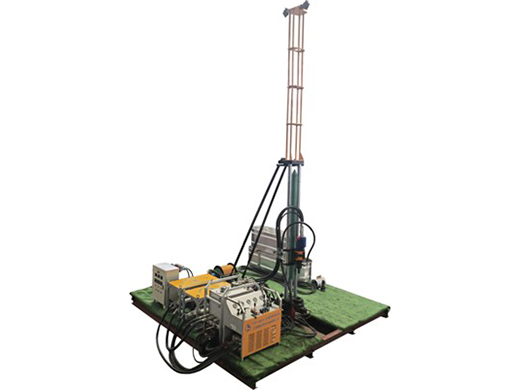
As a lightweight, portable, and easy-to-operate drilling equipment, portable drilling rigs play an irreplaceable role in modern engineering, exploration, scientific research, and other fields. Whether it's field geological survey, engineering construction sampling, or delicate operations in archaeological excavations, a suitable portable drilling rig can significantly improve work efficiency. This article will provide a comprehensive selection guide covering the definition, application fields, common types, key purchasing factors, and noteworthy brands of portable drilling rigs.
I. Portable Drilling Rig: Definition and Core Advantages
The core feature of a
portable drilling rig lies in its ""portability"" — compared to traditional large-scale drilling equipment, it is small in size, light in weight, and can be transported manually or by small vehicles, making it particularly suitable for operations in complex environments such as the wild, mountainous areas, and heritage sites. At the same time, it has a low operating threshold, allowing quick mastery without a professional team, and can complete drilling and sampling tasks in a short time. These advantages make it an ideal tool in fields such as geology, engineering, environmental protection, and archaeology.
II. Main Application Fields of Portable Drilling Rigs
Portable drilling rigs have a wide range of application scenarios, with different fields having varying functional requirements for the equipment:
1. Geological Exploration
In mineral resource investigation and engineering geological surveys, portable drilling rigs are used to obtain underground rock samples, helping engineers and geologists analyze stratum structures and rock properties, and providing data support for resource development and engineering design.
2. Engineering and Construction
Before foundation engineering construction, portable drilling rigs are needed to sample and analyze soil to evaluate foundation stability; they are also commonly used in road and bridge construction for geological condition investigation to ensure construction safety.
3. Environmental Monitoring
In the field of environmental monitoring, portable drilling rigs can be used to collect soil and groundwater samples, detect pollutant distribution, soil fertility, etc., providing a basis for environmental protection and governance plan formulation.
4. Archaeological Excavation
Archaeological sites have extremely high requirements for operational precision. Portable drilling rigs (especially hand-held core drills) can accurately obtain underground cultural relics or soil samples without damaging the site layers, helping archaeologists reconstruct historical information.
III. Common Types and Characteristics of Portable Drilling Rigs
According to differences in application scenarios and functions, portable drilling rigs are mainly divided into the following categories:
1. Portable Core Drilling Rig
Designed specifically for geological exploration, it can penetrate underground to obtain complete rock samples, suitable for scenarios requiring high-precision cores such as mineral resource investigation and engineering geological analysis. It is characterized by complete sampling and moderate drilling depth, meeting most field exploration needs.
2. Portable Vibratory Drilling Rig
Realizes rapid drilling through high-frequency vibration, mainly used in foundation engineering and soil analysis. It can efficiently obtain soil samples with little damage to the ground surface, suitable for operations in loose formations such as soft soil and sandy soil.
3. Portable Water Well Rotary Drilling Rig
Focused on hydrogeological surveys and small water well construction, it can drill groundwater samples or complete shallow water well construction. Its design emphasizes drainage and slag discharge efficiency, enabling stable operation in water-bearing formations.
4. Hand-Held Core Drilling Rig
The smallest and most flexible type, commonly used in delicate operations such as archaeological excavations and laboratory sampling. The body is lightweight, allowing single-person hand-held operation, and can accurately drill in narrow spaces or sensitive areas (such as cultural relic sites).
IV. Key Factors for Selecting a Portable Drilling Rig
When purchasing a portable drilling rig, comprehensive consideration of the following factors based on actual needs is necessary to avoid blind selection:
1. Clarify the Application Field
Different fields have significantly different requirements for rig types: geological exploration prioritizes core drilling rigs, archaeological excavations are suitable for hand-held ones, and engineering sampling can consider vibratory or rotary drilling rigs. Clarifying the scenario is the first step in selecting the right equipment.
2. Determine Drilling Depth and Diameter
Choose appropriate drilling parameters according to operational needs: small rigs are optional for shallow hole sampling (such as archaeology and environmental monitoring), while deep hole exploration (such as geological prospecting) requires equipment with stronger power and longer drill pipes. The diameter needs to match the sample size to avoid affecting data accuracy due to mismatched specifications.
3. Consider the Power Source
Portable drilling rigs mainly have three power sources:
- Gasoline Engine: Powerful, no need for external power supply, suitable for wild environments without power grids, but requires regular fuel addition, with relatively high noise and emissions;
- Electric Motor: Environmentally friendly, low noise, suitable for scenarios with high environmental requirements (such as urban areas and heritage sites), but dependent on power sources or batteries, and battery life needs to be planned in advance;
- Hydraulic System: Stable power, high efficiency, suitable for complex formations or long-term operations, but the equipment weight may be slightly larger, requiring a balance with portability.
4. Evaluate Portability
Focus on equipment weight and the convenience of disassembly and assembly: field operations require frequent movement, so priority should be given to models that can be disassembled and are lightweight (usually 10-50 kg); if is needed, the packaging size and carrying method (such as backpack or hand-held) should also be considered.
5. Consider the Budget Range
Portable drilling rigs range in price from several thousand yuan to tens of thousands of yuan, and a balance needs to be found between demand and budget: entry-level models with high cost performance can be selected for basic sampling, while mid-to-high-end equipment with more stable performance is recommended for professional exploration or long-term use.
V. Noteworthy Portable Drilling Rig Brands
Currently, there are multiple brands focusing on portable drilling rigs, each with its own characteristics, which can be selected according to needs:
- Dixin Survey Instruments: Mainly specializes in portable full-hydraulic core drilling rigs, with lightweight, efficient, and environmentally friendly as core advantages, suitable for geological exploration and engineering sampling.
- Inger Drilling: Provides modular and integral full-hydraulic core drilling rigs, equipped with thin-walled diamond wireline coring tools, with high sampling efficiency and precision.
- Tractafric Equipment: Its CAT® MD6200 drilling rig is characterized by being ""the smallest and most portable"", suitable for operation scenarios with strict space and weight requirements.
- Taobao: As a comprehensive platform, it brings together various types of portable drilling rigs, which can be screened according to application fields, prices, and other conditions, suitable for quick comparison and purchase.
Conclusion
Portable drilling rigs are important tools connecting surface and underground information. Selection requires consideration from multiple dimensions such as application scenarios, technical parameters, portability, and budget. It is hoped that this article can help you clarify your needs, select the most suitable equipment, and make drilling operations more efficient and precise."