Introduction
In mineral exploration, the drilling rig is only as capable as its ability to reach the drill site. Exploration targets increasingly lie in challenging terrain-rainforest-covered ground in Central Africa, steep slopes in the Andes, swampy lowlands in Southeast Asia, and frozen ground in northern Canada. In these environments, the mobility system of your drilling rig is not a secondary consideration-it is the primary determinant of whether your program succeeds or fails.
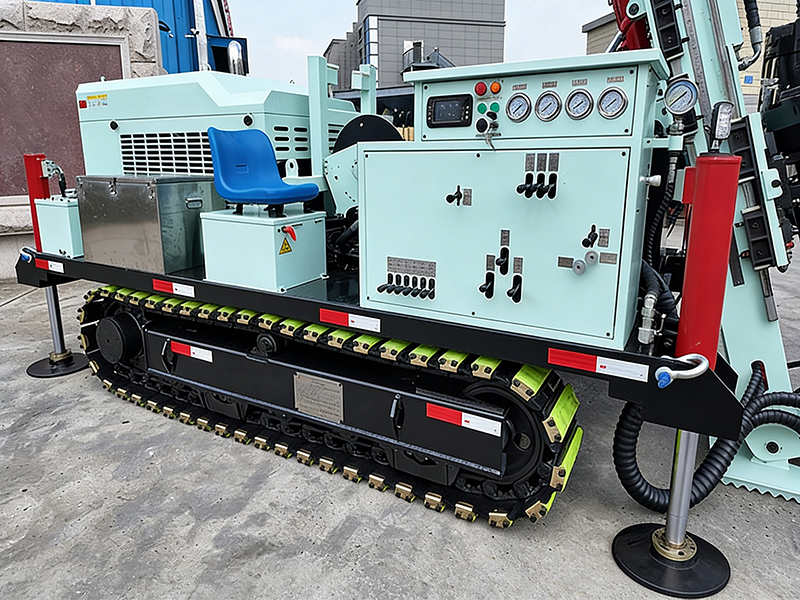
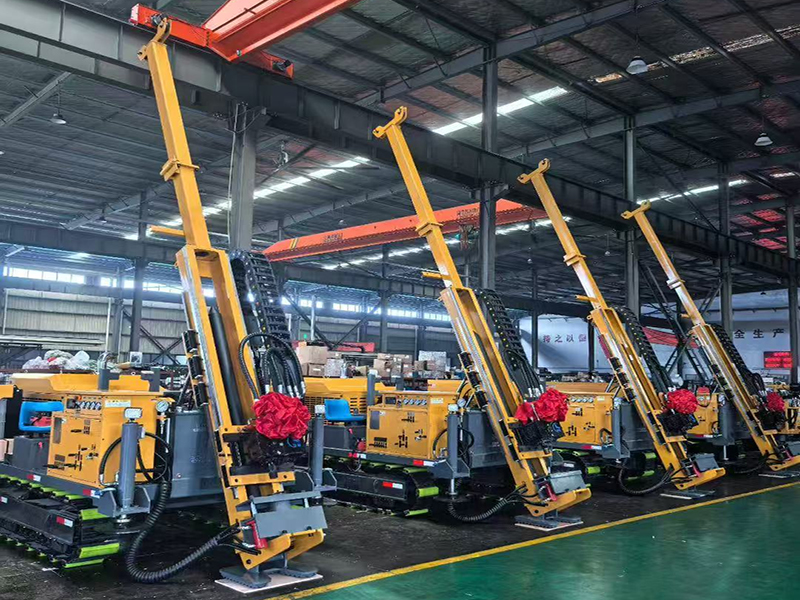
Crawler-mounted drilling rigs solve the terrain access problem by replacing wheels with tracked undercarriages that distribute rig weight across a large ground contact area. Understanding the technical characteristics, performance envelope, and selection criteria for crawler drilling rigs can mean the difference between completing your exploration program on schedule and abandoning drill holes due to access failures.
This guide covers the engineering principles of tracked mobility systems, compares crawler rigs against alternative undercarriage types, and provides practical selection criteria for different terrain environments.
Ground Pressure: The Core Physics of Tracked Mobility
Why Ground Pressure Matters
Ground pressure-the force per unit area exerted by a vehicle on the ground surface-is the fundamental parameter determining whether a vehicle can traverse soft terrain without sinking or becoming bogged.
Ground pressure formula:
Ground Pressure (kPa) = Total Weight (N) / Total Track Contact Area (m?2)
A standard wheeled vehicle exerts ground pressure of 200-500 kPa (29-73 psi), which exceeds the bearing capacity of soft soils. A tracked crawler with the same total weight exerts 30-80 kPa (4-12 psi)-well below the failure threshold of most soils.
Ground pressure comparison:
|
Vehicle Type |
Approximate Ground Pressure |
|
Passenger vehicle (4 tires) |
200-350 kPa |
|
Light truck |
150-250 kPa |
|
Heavy truck (8 tires) |
400-600 kPa |
|
Standard crawler track |
30-80 kPa |
|
Low-ground-pressure crawler |
15-35 kPa |
This five-to-tenfold reduction in ground pressure is why tracked vehicles can traverse soft ground that completely immobilizes wheeled transport.
Soil Bearing Capacity Reference
|
Soil Type |
Typical Bearing Capacity |
|
Dense sand/gravel |
300-600 kPa |
|
Firm clay |
100-250 kPa |
|
Soft clay |
25-75 kPa |
|
Peat / organic soil |
10-30 kPa |
|
Water-saturated silt |
<25 kPa |
Key insight: A standard crawler rig (40-60 kPa ground pressure) can operate on soft clay and firm peat. Low-ground-pressure crawlers (15-30 kPa) can traverse very soft clay, peat, and swampy ground. Wheeled vehicles cannot safely operate on any ground below 100 kPa bearing capacity.
Crawler Undercarriage Types
Rubber-Tracked vs. Steel-Tracked
|
Feature |
Rubber Track |
Steel Track |
|
Ground pressure |
Lower (flotation) |
Higher (penetration) |
|
Transport damage |
None (road legal) |
Can damage road surfaces |
|
Noise level |
Lower |
Higher |
|
Durability in rock |
Moderate |
Very high |
|
Ground adhesion |
Good |
Excellent |
|
Cost |
Higher |
Lower |
|
Typical use |
Mobile equipment, lighter rigs |
Heavy equipment, extreme terrain |
Rubber-tracked crawlers are preferred for exploration drilling rigs because:
They can be driven on public roads without special permits
They cause minimal damage to access roads and trails
They produce less vibration, reducing operator fatigue
They operate adequately on mixed terrain (mud, sand, slopes)
Steel-tracked crawlers are preferred for:
Extreme terrain with large obstacles and rock outcrop
Forestry and land clearing operations
Very heavy equipment where rubber track durability is insufficient
Undercarriage Suspension
Modern crawler undercarriages use torsion bar or bogey wheel suspension systems that allow each track unit to independently follow ground contours. This suspension:
Improves stability on uneven ground
Reduces shock loads transmitted to the drill rig
Allows higher speeds over rough terrain
Maintains consistent track tension under varying loads
Exploration drilling rigs should use undercarriages with oscillating bogey frames that allow each track unit to pitch and roll independently, maintaining ground contact on slopes and uneven surfaces.
Terrain Capability Analysis
Slope Operation
Crawler rigs can operate on slopes that would be impassable for wheeled vehicles, but slope capability depends on rig design, center of gravity, and ground surface.
Maximum safe slope ratings:
|
Condition |
Maximum Slope Angle |
|
Rubber track on dry grass/surface |
25-30deg (47-58%) |
|
Rubber track on wet grass/soil |
15-20deg (27-36%) |
|
Rubber track on rock |
30-35deg (58-70%) |
|
Steel track on rock |
35-45deg (70-100%) |
|
Steel track with anchors/chains |
Up to 45deg+ |
Critical safety concern: These are approximate maximums. Actual safe operating angles depend on the rig's center of gravity, whether the drill rig is set up on the slope, and whether anchor systems are deployed. Operators must assess each site individually.
Soft Ground and Swamp Operation
The primary advantage of crawler rigs in soft ground is their ability to:
Float on soft surfaces rather than sinking
Self-extract from soft ground through track mobility
Operate without site preparation (clearing, matting, or drainage)
For swamp exploration, crawler rigs can be equipped with extended track frames that further reduce ground pressure to 15-25 kPa. Some specialized swamp rigs use amphibious undercarriages with pontoon-style tracked units that provide additional buoyancy.
Swamp drilling preparation requirements:
Water depth typically must be <0.5-1.0m for standard crawlers to operate
Corduroy road (log corduroy) may be needed for water-saturated soils
Matting (steel or timber) is often required for very soft organic soils
Seasonal timing matters-frozen ground in winter can enable access otherwise impossible in summer
Frozen Ground and Permafrost
Crawler rigs are preferred in permafrost environments because:
Frozen ground provides excellent bearing capacity for tracked vehicles
Surface conditions are often consistent (frozen ground = predictable surface)
Summer thaw creates the most difficult conditions-crawler rigs can operate during frozen periods
Ground disturbance from tracks is minimized when ground is frozen
The most productive exploration windows in northern Canada, Russia, and Scandinavia typically occur during winter months (November-March) when frozen ground provides natural access. Crawler rigs enable drilling in areas that would be completely inaccessible during summer thaw.
Performance Comparison: Crawler vs. Truck vs. Skid Rigs
|
Parameter |
Crawler Rig |
Truck-Mounted Rig |
Skid-Mounted Rig |
|
Ground pressure |
30-80 kPa |
200-500 kPa |
50-150 kPa |
|
Max slope |
30-45deg |
10-15deg |
15-25deg |
|
Soft terrain |
Excellent |
Poor |
Moderate |
|
Swamp capability |
Good (with extended tracks) |
None |
Poor |
|
Road transport |
Requires trailer or disassembly |
Self-propelled |
Requires crane/loader |
|
Setup time |
Medium (15-45 min) |
Fast (5-15 min) |
Slow (30-60 min) |
|
Site footprint |
Medium |
Large |
Medium |
|
Drill depth capacity |
All ranges |
All ranges |
Typically <1,000m |
Crawler Rig Specifications for Different Exploration Scales
Light Crawler Rigs (300-500m capacity)
Target applications: Soil sampling, geotechnical drilling, early-stage exploration, environmental drilling
Typical specifications:
Engine: 50-80 HP diesel
Drill capacity: NQ to 300-500m
Ground pressure: 40-60 kPa
Transport weight: 4,000-7,000 kg
Transport width: 1.5-2.0m (road legal with narrow tracks)
Medium Crawler Rigs (500-1,000m capacity)
Target applications: Standard mineral exploration, resource definition drilling, geotechnical investigation
Typical specifications:
Engine: 100-180 HP diesel
Drill capacity: HQ to 500-1,000m
Ground pressure: 50-80 kPa
Transport weight: 8,000-15,000 kg
Transport width: 2.0-2.5m
Heavy Crawler Rigs (1,000-3,000m capacity)
Target applications: Deep exploration drilling, large-diameter geotechnical, scientific drilling
Typical specifications:
Engine: 200-400 HP diesel
Drill capacity: PQ to 1,000-3,000m
Ground pressure: 80-120 kPa
Transport weight: 15,000-35,000 kg
Transport width: 2.5-3.5m (may require special transport permits)
Key Takeaways
Crawler-mounted rigs achieve 30-80 kPa ground pressure versus 200-500 kPa for wheeled vehicles, enabling operation on soft clay, peat, and swampy terrain where wheeled rigs cannot function
Rubber-tracked crawlers are preferred for exploration drilling rigs due to road legality, reduced surface damage, and adequate durability for most terrain conditions
Slope operation is rated at 25-35deg for standard rubber crawlers on dry surfaces, but safe operation requires assessment of rig center of gravity, setup configuration, and ground surface conditions
Frozen ground and permafrost environments favor crawler rigs, with the winter drilling window (November-March) in northern latitudes providing optimal ground conditions for exploration access
Selection should match crawler capacity to exploration scale: light rigs (300-500m) for reconnaissance, medium rigs (500-1,000m) for standard exploration, heavy rigs (1,000-3,000m) for deep or large-diameter drilling
Conclusion
The mobility system of your drilling rig determines where you can drill, when you can drill, and how much site preparation is required before drilling can begin. For exploration programs in challenging terrain, the additional cost and complexity of a crawler-mounted rig is justified by the ability to access drill targets that would otherwise remain untested.
Crawler rigs have transformed exploration drilling in regions previously considered inaccessible-from the rainforests of West Africa to the mountain slopes of Central Asia. Without tracked mobility systems, vast mineral resources in soft and uneven terrain would remain undiscovered or unexplored only through expensive helicopter-supported drilling programs.
Wuxi PolySource Geological Equipment Co., Ltd. manufactures crawler-mounted core drilling rigs in light, medium, and heavy configurations, designed for global mineral exploration applications in all terrain conditions.