Introduction
Ground anchors and rock bolts are the structural backbone of modern geotechnical engineering. Without effective ground reinforcement, excavations would collapse, slopes would fail, and tunnels would be impassable. The drill rigs that create the holes for these reinforcement elements-and the technical expertise to deploy them-are essential infrastructure for mining operations, highway construction, dam engineering, and urban development.
Anchor drilling is distinct from mineral exploration drilling. The objective is not to retrieve samples but to create clean, straight holes of specified diameter and depth, within which a steel bar (the anchor) and grout column are installed. The drilling method must be compatible with the ground conditions, the installation requirements, and the structural specifications.
This article covers the technical foundations of anchor drilling, the specialized equipment used, key application areas, and practical guidance for engineers and project managers specifying anchor drilling services.
Understanding Ground Anchors and Soil Nails
Ground Anchors (Prestressed Anchors)
A ground anchor (also called a tieback or prestressed anchor) is a structural element installed in rock or soil to provide tensile resistance to imposed loads. The anchor transfers load from a structure (retaining wall, bridge abutment, dam face) to competent ground at depth.
Anchor system components:
Bond length (grouted section): The lower portion of the anchor bar encased in grout, bonded to the surrounding ground. Transfer load from the anchor to the competent strata.
Free (unbonded) length: The upper portion of the anchor bar between the structure and the bond length. Does not transfer load to the ground-allows the anchor to elongate under load.
Anchor head (bearing plate + wedge/hex nut): The mechanical connection at the structure face that transfers load from the structure to the anchor bar.
Corrosion protection: Mandatory for permanent anchors-typically double corrosion protection (DCP) with corrugated plastic sheath and grout encapsulation.
Anchor load capacities:
Temporary anchors: 400-1,500 kN typical
Permanent anchors: 200-3,000+ kN, with full corrosion protection
Specialized anchors: Up to 10,000+ kN for major infrastructure
Soil Nails
A soil nail is a passive reinforcement element-in contrast to prestressed ground anchors, soil nails are not pre-stressed after installation. They reinforce the ground by providing tensile resistance as the ground mass deforms.
Key differences from ground anchors:
|
Feature |
Ground Anchors |
Soil Nails |
|
Load application |
Prestressed before loading |
Passive (activates with ground movement) |
|
Installation timing |
Before or during excavation |
During excavation in stages |
|
Bond length |
Typically 4-12m |
Typically 3-10m |
|
Corrosion protection |
Mandatory for permanent |
Required for permanent |
|
Testing |
Mandatory (proof load or performance test) |
Typically proof-tested |
Anchor Drilling Rig Types and Specifications
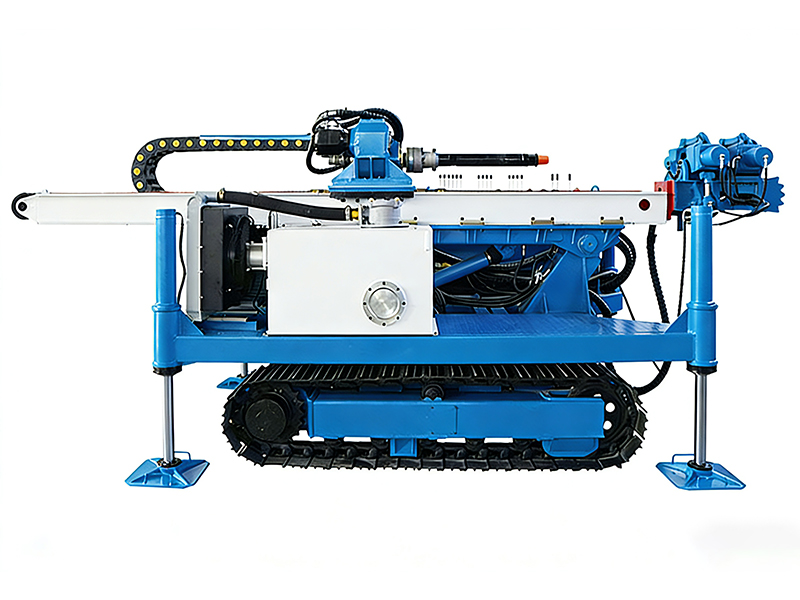
Hydraulic Top Head Drive Rigs
The most common type for anchor drilling. A hydraulic motor mounted on a feed system rotates and pushes the drill string into the ground.
Typical specifications:
Torque: 8,000-30,000 Nm
Feed force: 100-300 kN
Drill depth: 20-60m (standard); up to 100m+ with extensions
Hole diameter: 90-200mm
Power: Diesel or electric
Application: Rock and stiff soil anchor drilling, production soil nailing
Advantages:
High torque for hard rock drilling
Precise feed force control
Relatively compact for access-constrained sites
Can use various drilling methods ( rotary, percussion-rotary, down-the-hole hammer)
Rotary Drive Rigs (Cable Tool Type)
Older technology using a sliding cathead and rope to raise and drop a drilling tool. Still used in some applications.
Typical specifications:
Simpler mechanical design
Lower capital cost
Higher operator skill requirement
Slower penetration rates than hydraulic rigs
Application: Shallow anchor drilling in soft to medium ground
Mini-Anchor Rigs
Compact, low-profile rigs designed for confined space applications-interior basement construction, limited-access urban sites.
Typical specifications:
Machine height: 1.8-2.5m (can operate in reduced headroom)
Torque: 3,000-8,000 Nm
Drill depth: 10-25m
Hole diameter: 75-130mm
Application: Interior basement construction, tunneling, urban retrofit
Drilling Methods for Anchor and Soil Nail Installation
1. Rotary Drilling with Drag Bits or Tricone Bits
The drill string rotates while weight is applied; cuttings are removed by drilling fluid (water, mud, or air) circulated down the drill string and up the annulus.
Best for: Medium to hard rock, stiff clays, chalky formations Hole diameter: 90-200mm Drilling speed: Moderate to fast in appropriate formations
2. Rotary-Percussive Drilling (Down-the-Hole Hammer)
A pneumatically-driven hammer at the bottom of the drill string delivers percussive impacts directly to the bit face while rotary motion provides cutting.
Best for: Hard rock (granite, basalt, limestone), high production requirements Hole diameter: 90-180mm Drilling speed: Fast in hard rock; slower in soft ground Advantage: Significantly faster penetration rates in hard rock compared to rotary-only methods
3. Auger Drilling (Continuous Flight Auger)
A continuous helical auger is rotated into the ground; soil is transported to the surface by the auger flights without a separate flushing system.
Best for: Cohesive soils, soft rock, cohesionless sands above water table Hole diameter: 75-300mm Depth limit: Typically 20-35m without specialized equipment Limitation: Cannot penetrate hard rock; difficult in water-bearing cohesionless sands
4. Cased Drilling (Drill and Case Simultaneously)
A casing tube is advanced simultaneously with drilling, preventing hole collapse in unstable ground. Used in weak, fractured, or water-bearing formations.
Best for: Fractured rock zones, loose sand and gravel, water-bearing formations Hole diameter: 100-250mm Method: Casing advanced with rotary or rotary-percussive method; drill string inside casing does the cutting Advantage: Hole stability guaranteed regardless of ground conditions
Key Application Areas
1. Mining Slope Stabilization
Open-pit mines routinely excavate to depths of 300-500+ meters, creating steep high walls that are inherently unstable. Ground anchors and rock bolts are installed to:
Reinforce critical failure surfaces identified in geotechnical analysis
Prestress the slope to control deformation during mining
Secure catch benches and reduce rockfall hazard
Support portal and pit highwalls in transition to underground mining
Typical specifications in mining:
Anchor loads: 400-2,000 kN
Bond lengths: 6-15m in competent rock
Hole diameters: 115-180mm
Drill rig requirements: High torque (25,000+ Nm), capable of angles 0-90deg from horizontal
2. Infrastructure Slope Stabilization
Highway cuts, railway excavations, and urban development on hillsides all require slope stabilization. Common applications:
Rockfall protection on highway cuts through mountainous terrain
Deep excavation support for high-rise building basements in urban areas
Landslide stabilization for existing slopes showing movement
Bridge approach stabilization where approach embankments require reinforcement
3. Dam and Reservoir Engineering
Dams and their associated reservoirs create unique loading conditions on surrounding slopes:
Reservoir rim stability must be maintained to prevent landslides into the reservoir
Spillway and outlet structures require anchored foundations
Gravity dams are anchored to rock foundations using prestressed anchors
Dam rehabilitation often involves installing new anchors to increase safety factors
4. Tunnel Support
Underground construction in rock requires immediate support to prevent overbreak and collapse:
Rock bolts (short anchors) are installed at close spacing (1-2m) in tunnel crowns and walls
Shotcrete (sprayed concrete) is applied concurrently with rock bolting for immediate support
Forepoling uses steel tubes or pipes drilled ahead of the tunnel face for weak ground conditions
Key Takeaways
Anchor drilling rigs are specialized equipment for creating holes for ground anchors, soil nails, and rock bolts, with the primary objective of efficient hole creation rather than sample recovery
Ground anchors are prestressed tensile elements with a bonded (grouted) lower section and an unbonded upper section; soil nails are passive reinforcement that activates with ground deformation
Key drilling methods for anchor installation: rotary drilling (medium to hard rock), down-the-hole hammer (hard rock, high production), auger drilling (soft ground), and cased drilling (unstable ground)
Primary applications include open-pit mine slope stabilization (400-2,000 kN anchor loads), infrastructure cuts, dam reinforcement, and tunnel rock support
Selection criteria: drill rig torque (8,000-30,000 Nm for standard applications), feed force, hole diameter range, terrain mobility, and power source matching to site conditions
Conclusion
Anchor drilling is a critical enabling technology across mining, civil infrastructure, and energy projects. The performance of the ground anchors-and thus the stability of the structures they support-depends on the quality of the drilled holes and the correctness of the installation procedure.
Selecting the right drilling method and equipment for each ground condition is a technical decision with direct safety and cost implications. Overly conservative approaches lead to unnecessary cost; insufficiently robust approaches risk anchor failure and structural instability.
Wuxi PolySource Geological Equipment Co., Ltd. manufactures hydraulic anchor drilling rigs and full hydraulic tunnel drilling rigs designed for geotechnical engineering applications in mining and civil construction.