Impregnated Diamond Drill Bits: Selection Guide, Performance Factors, And Best Practices For 2026
Release time:2026-07-17
Visits:313
Introduction
The diamond drill bit is the business end of any core drilling operation-and the impregnated diamond bit is the workhorse of hard rock exploration. Unlike surface-set bits where diamonds are exposed on the crown surface, impregnated bits embed diamond crystals throughout the entire matrix crown. As the matrix wears during drilling, fresh diamonds are continuously exposed, maintaining cutting efficiency throughout the bit's life.
This self-sharpening characteristic makes impregnated diamond drill bits remarkably versatile, but it also makes proper selection critical. Choose the wrong matrix hardness for your formation, and you'll either glaze the bit (no penetration) or burn the diamonds (rapid wear). Get it right, and a single bit can drill hundreds of meters of hard rock with consistent performance.
This guide provides a practical framework for selecting, operating, and maintaining impregnated diamond drill bits in mineral exploration drilling.
How Impregnated Diamond Drill Bits Work
The Impregnation Principle
Impregnated diamond drill bits have a metal matrix crown (typically tungsten carbide with a bronze or cobalt binder) throughout which fine diamond crystals are uniformly distributed. The diamond concentration typically ranges from 75 to 125 carats per cubic meter of matrix (corresponding to 25%-40% diamond volume fraction by category).
During drilling, the matrix wears at a rate determined by:
Formation hardness relative to matrix hardness
Drilling parameters (WOB, RPM, hydraulic flow)
Diamond grit size and quality
Waterway design affecting coolant flow
As the matrix wears, embedded diamonds at the crown surface are progressively exposed, providing a continuously fresh cutting face. This is why impregnated bits are also called "self-sharpening" bits-they do not require replacement or re-setting like surface-set bits.
Bit Anatomy
Understanding bit components is essential for selection:
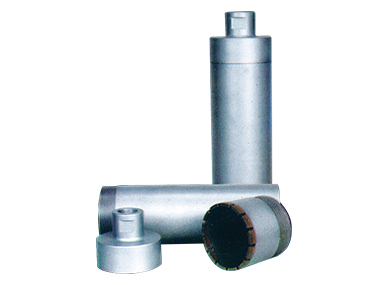
Crown: The diamond-bearing matrix at the drilling face; the active cutting surface
Blank/Body: The steel body to which the crown is bonded; contains waterway channels
Waterways: Slots or channels that direct drilling fluid to the crown face for cooling and cuttings evacuation
Gauge (OD): The outer diameter maintained by gauge diamonds or wear pads
Inner diameter (ID): The inner crown edge, critical for core reception and clearance
Profile: The crown shape (flat, semi-rounded, rounded) affecting footage and hole stability
Diamond Grit Size Selection by Formation
Diamond grit size directly controls penetration rate and bit life. The relationship is inverse: larger diamonds = faster penetration = shorter bit life.
Standard Grit Size Ranges
|
Grit Size |
Mesh |
Application |
|
Coarse |
6-20 mesh (~1-3mm) |
Very soft, abrasive formations (salt, soft limestone, coal) |
|
Medium |
20-40 mesh (~0.4-1mm) |
Medium-hard formations (sandstone, phyllite, soft granite) |
|
Fine |
40-60 mesh (~0.25-0.4mm) |
Hard formations (basalt, hard granite, banded iron formation) |
|
Very Fine |
60-80 mesh (~0.18-0.25mm) |
Very hard, low-abrasion formations (quartzite, chert, competent basalt) |
Practical selection rule: Match diamond size to formation resistance. Hard, competent rock requires smaller diamonds to maintain adequate diamond count on the crown face. Soft, abrasive formations require larger diamonds to resist embedment and improve ROP.
Common Mistakes in Grit Selection
Using too fine a diamond in soft rock: The matrix won't wear fast enough to expose fresh diamonds, causing bit glazing
Using too coarse a diamond in hard rock: Individual diamonds fracture rapidly under high formation resistance, causing accelerated wear and poor footage
Matrix Hardness Selection
Matrix hardness is perhaps the most critical selection variable. The matrix must be softer than the rock being drilled so that it wears at the correct rate to expose diamonds progressively.
Matrix Hardness Classification
|
Matrix Class |
Hardness (HRA) |
Application |
|
Very Soft |
25-35 HRA |
Extremely soft, high-abrasion formations |
|
Soft |
35-45 HRA |
Soft to medium formations (shales, sandstones) |
|
Medium |
45-55 HRA |
Medium to medium-hard formations (granite, andesite) |
|
Hard |
55-65 HRA |
Hard, low-abrasion formations (basalt, quartzite, iron formation) |
|
Very Hard |
65-80 HRA |
Very hard, abrasive formations |
Matrix-Formation Matching
Soft matrix bits (35-45 HRA) are designed for drilling soft to medium formations where rapid matrix erosion is needed to expose diamonds. They will rapidly overwear in hard rock-the matrix wears faster than the rock, exposing too much diamond at once and causing premature failure.
Hard matrix bits (55-65 HRA) are designed for hard rock where controlled matrix wear maintains optimal diamond protrusion. In soft formations, the hard matrix won't wear fast enough, leading to bit glazing-diamonds become polished and lose cutting ability.
The fundamental principle: The matrix must always be softer than the formation. When in doubt about formation hardness, start with a softer matrix bit.
Bit Profile Selection
Bit profile-the three-dimensional shape of the crown-affects footage drilled, hole stability, and core recovery.
Standard Profiles
|
Profile |
Description |
Application |
|
Flat Face |
Crown face is flat or slightly concave |
General purpose; good footage; requires active balling |
|
Semi-Rounded |
Crown face is partially rounded |
Reduces balling in sticky formations; better in broken ground |
|
Rounded (Tulip) |
Crown face is fully rounded |
Best for broken, fractured formations; highest core recovery |
|
Stepped |
Crown has recessed outer or inner diameter |
Specialized for certain ground conditions |
Profile selection guidance:
Flat face: Start with this profile for most standard drilling in competent rock
Semi-rounded: Switch when drilling through clay-rich or schistose formations where bit balling is common
Rounded: Use in highly fractured, blocky ground where core loss is a concern
Waterway Design and Hydraulic Parameters
Proper cooling and cuttings evacuation are essential for bit performance and life. Insufficient hydraulic flow causes thermal damage to both diamonds and matrix.
Waterway Types
|
Type |
Description |
Application |
|
Spiral waterways |
Helical channels cut into the crown |
Standard applications; good debris evacuation |
|
Radial waterways |
Straight channels from center to gauge |
Higher flow capacity; better in coarse cuttings |
|
Tapered waterways |
Channels that narrow toward center |
Specialized; not common in exploration |
Hydraulic Guidelines
Minimum flow rates by bit size:
|
Bit Size |
Minimum Flow Rate |
|
AQ (27mm) |
20-30 L/min |
|
BQ (36mm) |
30-45 L/min |
|
NQ (48mm) |
45-70 L/min |
|
HQ (63mm) |
70-100 L/min |
|
PQ (85mm) |
100-150 L/min |
Hydraulic horsepower (pressure x flow) at the bit face should be sufficient to:
Remove cuttings from the bit face before they can be recut
Cool the diamonds and matrix to prevent thermal damage
Maintain clean waterway channels throughout the drilling run
Common Problems and Solutions
Problem: Bit Glazing (No Penetration)
Symptoms: RPM and WOB are normal, but penetration rate drops to near zero within minutes. Bit crown appears polished.
Cause: Matrix is too hard for the formation. The matrix doesn't wear fast enough to expose fresh diamonds; exposed diamonds become polished (glazed) and lose cutting ability.
Solution:
Use a softer matrix bit (1-2 hardness grades softer)
Increase WOB slightly to accelerate matrix wear
Use a smaller diamond grit size for faster self-sharpening
Consider using a different bit type (surface-set or tungsten carbide inserts)
Problem: Rapid Bit Wear (Short Footage)
Symptoms: Penetration rate is normal initially, but drops off quickly over 5-10 meters. Inspection shows matrix worn excessively or diamonds lost prematurely.
Cause: Matrix is too soft for the formation, or drilling parameters (WOB, RPM) are too aggressive.
Solution:
Use a harder matrix bit (1-2 grades harder)
Reduce WOB and adjust RPM to match formation
Check that hydraulic flow is sufficient to cool the bit face
Verify that the correct grit size is being used
Problem: Core Loss
Symptoms: Core Recovery % drops below expected values, especially in fractured or soft formations.
Cause: Core barrel design or drilling parameters allow core to be washed, broken, or lost during retrieval.
Solution:
Switch to a core lifter or inner tube assembly appropriate for the formation
Reduce flushing pressure in soft, fractured zones
Use a rounded-profile bit for improved core reception
Consider using a double-tube core barrel instead of a single-tube design
Key Takeaways
Impregnated diamond drill bits embed diamond crystals throughout the matrix crown, providing continuous self-sharpening as the matrix wears during drilling
Diamond grit size (6-80 mesh) inversely affects penetration rate and bit life: coarser diamonds drill faster but wear faster; 20-60 mesh is standard for exploration drilling
Matrix hardness (25-80 HRA) must be softer than the formation being drilled; soft matrix (35-45 HRA) for soft rock, hard matrix (55-65 HRA) for hard rock
Bit profile selection (flat, semi-rounded, rounded) affects footage, hole stability, and core recovery-flat face for competent rock, rounded for fractured ground
Proper hydraulic flow (30-150 L/min depending on bit size) is essential to prevent bit glazing and thermal damage, which are the two most common causes of premature bit failure
Conclusion
Selecting the right impregnated
diamond drill bit requires balancing five key variables-formation hardness, desired penetration rate, expected footage, core recovery requirements, and drilling parameters. No single combination is optimal for all conditions, which is why experienced drilling supervisors maintain a selection of bit types and matrix hardnesses for different formations.
The self-sharpening nature of impregnated bits makes them forgiving compared to other bit types, but that does not eliminate the need for proper selection. Glazing and rapid wear remain common problems that directly reduce drilling efficiency and increase cost-per-meter.
For mineral exploration drilling programs that demand consistent penetration rates and reliable footage, bit selection should be treated as a technical decision with measurable financial impact, not an afterthought. Wuxi PolySource manufactures a full range of impregnated diamond drill bits in standard sizes (AQ through PQ) with matrix hardnesses optimized for global exploration drilling conditions.