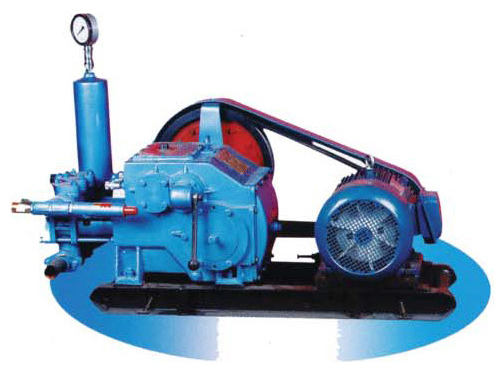
In industrial production and engineering construction, there is a device that seems unremarkable but plays the role of a ""conveying main force"" in multiple fields - it is the mud pump. As a specialized pumping equipment for transporting mud and other suspended liquids, mud pumps, with their unique performance, have become indispensable key tools in industries such as oil extraction, construction, and environmental protection. This article will comprehensively analyze the ""strengths"" of mud pumps from their working principles and application fields to core features.
Working Principle of Mud Pumps: How to Achieve Efficient Conveying?
The core function of a
mud pump is to stably and efficiently transport suspended liquids containing solid particles (such as mud, ore pulp, sludge, etc.) to the target location. Its working principle is based on the synergistic effect of ""reciprocating motion"" and ""valve control"":
The power machine (such as an electric motor or diesel engine) drives the crankshaft of the pump to rotate. The crankshaft converts the rotational motion into the reciprocating motion of the piston or plunger in the pump cylinder through a crosshead structure. When the piston/plunger moves outward, a negative pressure is formed in the pump cylinder, the suction valve opens, and mud is sucked into the pump cylinder; when the piston/plunger moves inward, the pressure in the pump cylinder increases, the discharge valve opens, and mud is pushed out of the pump cylinder. Through the alternate opening and closing of the suction and discharge valves, the mud pump realizes a continuous ""suction-discharge"" cycle, thereby completing the pumping and circulation of mud.
Currently, the most widely used types of mud pumps are piston-type and plunger-type. The advantage of these pumps is that they can easily handle high-concentration, high-viscosity suspended slurries, even those containing large particles, avoiding the efficiency reduction problems of ordinary pumps caused by blockage or wear.
Application Fields of Mud Pumps: A ""Versatile Player"" from Underground to Water
The ""versatility"" of mud pumps makes them irreplaceable in multiple industries. Whether it is resource extraction deep underground, surface engineering construction, or water environment governance, they can be seen:
1. Oil and Gas Industry
In drilling operations, mud pumps are the core of the ""drilling fluid circulation system"". They continuously pump specially formulated drilling mud (containing clay, water, and chemical additives) into the wellbore. On one hand, it cools the high-speed rotating drill bit; on the other hand, it carries the cut rock debris back to the surface. At the same time, it can balance formation pressure and prevent safety accidents such as blowouts.
2. Construction Engineering
In foundation construction (such as pile foundations, diaphragm walls) or tunnel excavation, groundwater and mud often accumulate at the construction site. Mud pumps keep the working surface dry by pumping and draining these liquids, ensuring construction safety and efficiency. For example, in subway tunnel construction, mud pumps can promptly remove water seepage and mud from the tunnel face, clearing obstacles for the advancement of the shield machine.
3. Mining Industry
During mineral extraction, a large amount of mud containing slag is generated (such as beneficiation tailings from gold and iron mines). Mud pumps are responsible for transporting these slurries to sedimentation tanks or subsequent treatment links, avoiding environmental pollution from slag accumulation and realizing resource recycling.
4. Environmental Protection Industry
In sewage treatment plants, the transportation of sludge is a major challenge - sludge has high concentration and viscosity, which ordinary pumps cannot handle. With strong conveying capacity, mud pumps can stably transport concentrated sludge to dehydration equipment or landfills, aiding sewage purification and solid waste treatment.
5. Geological Exploration
During geological drilling, mud pumps are used to transport drilling mud. Mud can not only cool the drill bit and remove cuttings but also protect the borehole wall and prevent hole collapse, providing a guarantee for obtaining underground geological data.
6. Metallurgical and Chemical Industries
In the metallurgical process, such as blast furnace slag treatment in steel plants and hydrometallurgy of non-ferrous metals, a large amount of slurry is generated; in chemical production, some raw materials or by-products are high-viscosity, particle-containing media. Mud pumps can safely transport these special media, ensuring the continuous and stable production process.
7. Paper Industry
In the papermaking process, the transportation and circulation of pulp require stable power. Mud pumps can precisely control the pulp flow, avoid fiber breakage, and ensure paper quality.
8. River Dredging
To improve river navigability or remove underwater silt, a large amount of mud (a mixture of water and silt) needs to be transported from the bottom to designated dumping sites in dredging projects. The high conveying efficiency and anti-clogging ability of mud pumps make them the ""main force"" in dredging operations.
9. Aquaculture
In aquaculture scenarios such as fish ponds and shrimp ponds, mud pumps can be used to clean up bottom silt and improve water quality; at the same time, by circulating and transporting water, dissolved oxygen is increased, providing a good growth environment for aquatic animals.
Core Features of Mud Pumps: Why Can They Adapt to Complex Working Conditions?
The reason why mud pumps can ""gain a foothold"" in multiple industries is inseparable from their unique performance advantages:
- Strong conveying capacity: Designed specifically for high-concentration, high-viscosity, and particle-containing suspended slurries, it can stably transport even when the slurry contains solid particles with a diameter of several centimeters, and is not easy to block.
- Stable conveying flow: There is no overflow or pulsation during operation, and it will not stir or shear particles in the slurry (such as slag, fibers), protecting the integrity of materials.
- Stable discharge pressure: The discharge pressure is independent of the rotation speed. Even under low flow conditions, it can maintain a high discharge pressure, meeting the requirements of long-distance or high-lift transportation.
- Flexible flow adjustment: The flow is proportional to the rotation speed. Through a variable speed mechanism (such as a gearbox) or a speed-regulating motor, stepless adjustment of the flow can be easily achieved to adapt to the conveying requirements of different scenarios.
- Strong self-priming ability: No need to install a foot valve, it can directly suck liquid from low-level or open containers, simplifying the installation process and reducing use costs.
- Reversible operation: By changing the rotation direction of the pump, the liquid flow direction can be switched, which is suitable for occasions that require forward and reverse flushing of pipelines (such as dredging pipeline cleaning).
- Stable operation: Optimized structural design, low vibration and noise, reducing the impact on the surrounding environment and extending the service life of the equipment.
- Simple structure: Core components (such as pistons, valves) are easy to disassemble and assemble, and the difficulty of daily maintenance and repair is low, reducing downtime.
Summary: Mud Pumps - A ""Reliable Partner"" in Industrial Conveying
From underground drilling to river dredging, from sewage treatment to mine beneficiation, mud pumps have become (indispensable equipment) in multiple industries with their strong adaptability and stability. With the advancement of technology, modern mud pumps are continuously upgraded in materials, structure, and intelligent control, not only able to cope with more complex working conditions but also achieve energy conservation and consumption reduction. Whether it is ensuring project progress or promoting environmental governance, mud pumps are silently playing a key role, becoming an indispensable ""conveying tool"" in industrial production."